We are a Dometic Sanitation SuperTech Dealer as well as Dometic ACR Dealer.
Charleston Yacht sells, installs, and services the innovative Arid Bilge System.
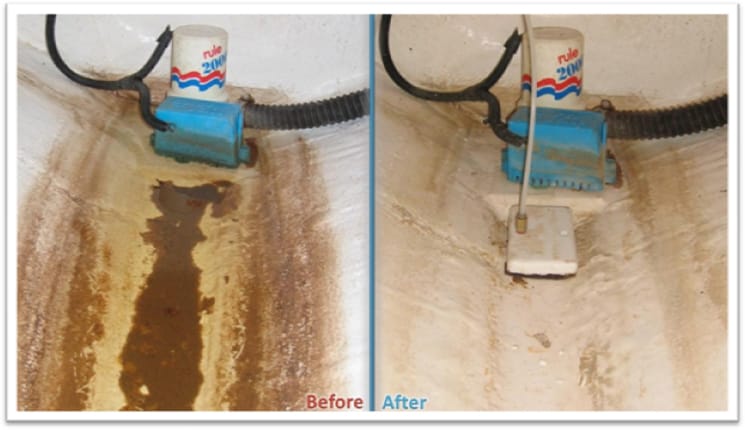
We believe that maintaining a clean and dry bilge is the best step you can take towards ensuring a comfortable and healthy onboard environment for you and your guests.
Not only does the maintenance of a clean and dry bilge improve your day-to-day experience of the boat, but it also helps prevent the premature aging of all onboard systems and improves the resale value of your boat.
We specialize in retrofitting a wide range of vessels — e.g., center consoles, Sport Fishing Boats, and Super Yachts — to help you prevent the damage that standing bilge water can cause and transform your boating experience.
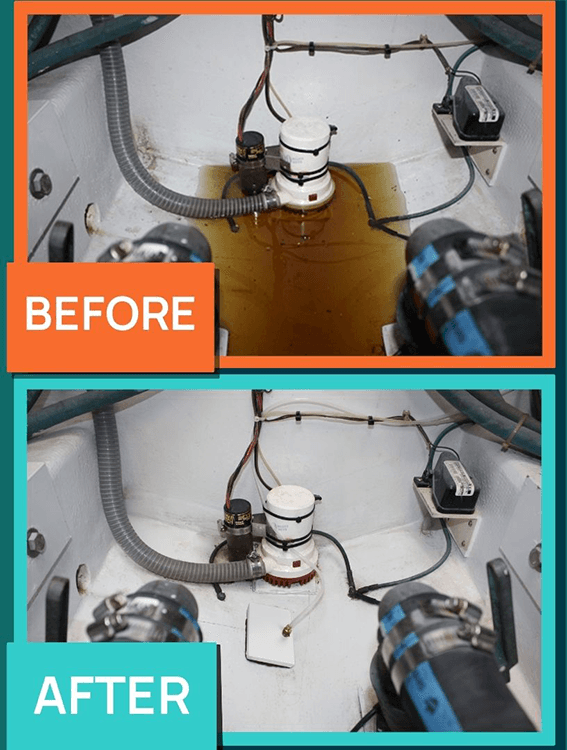
The Arid Bilge System uses vacuum to remove every last drop of bilge water. This is the same technology as your wet/dry shop vac, but it’s completely automatic and precise. Arid Bilge is not a bilge pump, which has a float switch that sits in water. Instead of a traditional float switch, the Arid Bilge has a pair of vacuum switches which measure how quickly vacuum is being lost in the collection chamber. Slow loss of vacuum signals to the system that liquids are being pulled, which prompts the processor to keep the system active.
It’s normal for boats to have water in the bilge on occasion for various reasons, but standing bilge water can lead to serious problems over time.
Standing water, even in small amounts 2 inches deep or less, leads to:
• The “mature vessel smell” that no chemicals can eliminate,
• Mold and mildew in everything from the fabrics to the fiberglass,
• High humidity below decks and in cabins,
• Rust and condensation damage on engine room machinery and electronics,
• Hull osmosis or corrosion.
It also prevents boaters from locating the source of a leak.
Standing bilge water will reduce your boat’s resale value and will increase your maintenance costs.
Most importantly, standing bilge water will reduce your enjoyment of the boat.
All of the problems caused by standing bilge water will be halted in their tracks. Our customers notice the following types of changes:
• The “mature vessel smell” dissipates,
• No more harsh cleaning chemicals are needed,
• On-board humidity goes down,
• Maintenance costs are reduced.
Now instead of playing defense, you can play offense. Arid Bilge will enable you to be proactive rather than reactive. For example, if the boat has any leaks, the Arid Bilge System will help you find them and fix them before they become a problem. Your bilge paint will be protected from the dangers of standing water. The boat will hold a better resale value and will impress your guests and potential buyers.
The number of zones is often correlated with the number of bilge pumps, but sometimes there are additional areas that pocket water and are not serviced by a bilge pump, e.g., an A/C drip pan.
How to determine the number of zones that you’ll need: Send a technician to the boat with a shop vac. They should place the nozzle at the lowest point of all compartments that collect water and count how many separate areas they need to vacuum to get the bilges completely dry. This will determine the required number of zones.
If the boat is not in the water yet, then you may wish to wait until you have some real-world experience with the movement of bilge water in this particular hull design before counting the zones. The builder may also be able to advise.
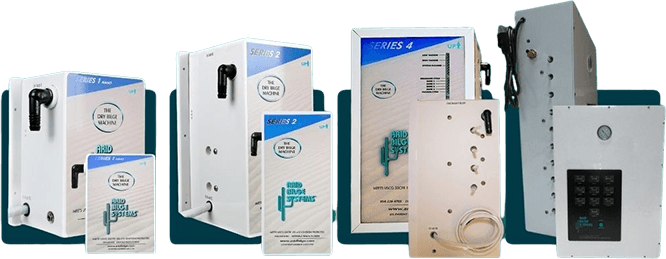
• Series 1 – Ideal for boats needing a single intake zone. Compact and efficient. Intake tubing can stretch up to 20 feet from the central unit.
• Series 2 – Designed for boats that need 2 or 3 intake zones, intake tubing can stretch up to 50 feet from the central unit. Our most popular unit.
• Series 4 – Handles from 4 to 8 intake zones, a favorite on larger yachts, catamarans, and wooden boats. Intake tubing can stretch up to 75 feet from central unit.
The physical central unit is larger than an average bilge pump, but it can be mounted in any out-of-the-way location, usually up on a bulkhead like a battery charger. The actual tubing and bilge pickup footers are quite small and usually end up being located near the bilge pumps.
Our most popular unit, the Series 2, draws 7/10 of an amp at 12 volt DC when it’s running cycles and removing bilge water. When it’s in the hibernate mode, it draws 20 milliamps — this is where the unit will usually spend most of its time. An easy number for most of us to understand would be that this system usually draws 1.6 ampere hours per day.
Other versions, such as the Series 1 and Series 4, draw similarly small amounts of power.
We’re happy to provide contact(s) for installers or yards in your area if you want to keep it simple. But if you enjoy and have the time to do the installation, it’s usually much easier and faster than installing a common bilge pump from scratch.
View our Series 4 install video here for best practices on cutting and running tubing, hooking up to power, and more.
All installation manuals are available on the Owners’ Central page and contain much more detail on installation.
You can find the full installation manual and more specifications on the “Description” tab on each of our shop pages:
Click here for Series 1
Click here for Series 2
Click here for Series 4
There may be a lot of slime down in the bilge today. Once the Arid Bilge is installed, you can clean the bilge one more time and say goodbye to the slime. Slime won’t be coming back and therefore it won’t be clogging your Arid Bilge pickups. No regular maintenance required here.
The best thing you can do for your Arid Bilge System is to leave power applied and stop using foaming bilge cleaners. Not only do they pollute the environment, but the suds from cleaning products can damage the Arid Bilge System’s internal components.
If you do have to use foaming cleaning products, shut off power to the Arid Bilge System and have the bilge pump activate to flush out the sudsy water.
Three major differences:
You need both pieces of equipment on your boat to keep it healthy and safe.
There are different types of bilge pumps that all have a single thing in common: they have an impeller or diaphragm that comes in direct contact with the bilge water. Bilge pumps are very efficient while they are pumping liquid. But as soon as air is mixed with the water, the pump’s efficiency drops dramatically to the point that the pump might completely stop moving water even though it’s still running. In the industry, we call this “cavitation,” which is the slipping of the impeller through the air.
The Arid Bilge System, on the other hand, is essentially a miniature wet or shop vacuum cleaner. Our system works by moving air to move liquid. Our float switch and our pump never come in contact with the bilge water. This ensures maximum longevity of our product.
There are no technologically similar alternatives to Arid Bilge besides manual labor using a conventional wet/dry shop vac. Note that Arid Bilge is not considered an alternative to bilge pumps because it uses completely different technology (see previous 2 FAQs).
Boaters that live aboard or owners of larger yachts with a full-time crew will use a wet/dry shop vac to manually remove all of the bilge water at regular intervals. This is a very labor-intensive and messy process. Ever try lifting a shop vac full of dirty water out of a rectangular hole in the floor, only to drip all over clean carpet on your way to pour it out overboard? Yes, we have heard of boaters using a sponge or a hand pump instead, but in the end that’s just as messy and time-consuming as using the shop vac. Why not automate this process?
Oil, hydraulic fluid, and Diesel fuel mixed with bilge water will usually not cause any problems for the Arid Bilge System. These liquids will pass through the system without harming the system.
However, you should treat bilge water if it is particularly oily, so you stay in compliance and protect our environment. Most boats have to maintain a placard, usually posted in the engine room, stating that it is illegal to discharge Hydrocarbons overboard and that it can result in a $10,000.00 fine, etc.
The Arid Bilge by itself would pass these fluids overboard like most bilge pumps would as well. If you are concerned about the amount you may be discharging, we offer three models of oily-water separators as add-on devices. These are designed to allow the bilge water to pass through while storing the oil and/or Diesel for manual removal and proper disposal. Most of our customers don’t have the need for this.
Read our article on treating bilge water for general tips on handling bilge water, including when to use soaps and what type of soaps.
Every boat is different. Some have continuous, slow leaks, while others have intermittent leaks that may happen during rainstorms. We have seen some systems last up to 13 years without any repairs while others, usually on an old wooden boat, may have problems right at one year because of normal wear and tear on the unit. We average right around 5 to 6 years on most of our units and the reason is simple: no direct contact between the pump / float switch and the bilge water. This ensures maximum longevity of our product.
Short answer: If your Arid Bilge System has capacity, yes, you can send the unit back to us to upgrade to add more zones.
Detailed answer: A Series 1 cannot be upgraded to have 2 zones. A Series 2 with 2 zones can be upgraded to have 3 zones. A Series 4 can be upgraded to have up to 8 zones. All such upgrades take place at our factory in Florida. Trying to perform the upgrade yourself can cause the system to lose calibration. Please contact us to make sure your unit can be upgraded. You will pay the difference between the sale price of your current unit and the SKU you want to upgrade to, plus roundtrip shipping, plus a $100 service fee (subject to change), and your unit will be returned to you with additional tubing and bilge pickup(s) as required by the upgrade. If upgrading a Series 4 to have 7 or 8 zones, the service fee is $200 because the 4×7 and 4×8 systems include hour meters.
All of our systems require a compressor in order to function. Each system has a different sized compressor, and the compressors are louder as they increase in size. The compressor runs a few times every 3 hours when the system is doing its checks on each zone. The compressor in our Series 4 has sometimes been known to be audible when running inside a boat, depending on the installation. We continually improve our products, and over the years we have used compressors from 3 different manufacturers. The current compressor is the quietest of those by more than half the volume. The average AC blower motor on a boat, pushing air through, is louder and will drown out any noises from the Arid Bilge System. Additionally, if you can mount the unit in your engine room, the noise from the compressor will blend with any other machinery noise. Mounting the unit in the engine room is ideal because the bulkhead(s) will provide additional sound insulation between the unit and the guest staterooms.
If you want to be sure that the compressor noise is as muted as possible, you should carefully evaluate the desired mounting location. Is the bulkhead relatively thin? Test it by tapping it and listening for a hollow sound. A thin fiberglass can act like a bass drum and amplify vibrations. If you need to mount to a thin fiberglass bulkhead, you can install a mounting panel between the unit and the bulkhead to help absorb the compressor’s vibrations and prevent the thin fiberglass from amplifying the vibrations. Use 5200 and a minimum number of mounting screws to affix a wood mounting board to the bulkhead, and mount the Arid Bilge unit to the wooden board once the 5200 has cured. The wood board should be larger in area than the back mounting plate of the Arid Bilge System, and at least 5/8″ but preferably 3/4″ thick.
If you wish to be able to turn the unit off when you’re spending time on the boat, please give it a dedicated breaker on the electrical panel. You can turn off power if the compressor bothers you — it won’t hurt the unit. Just remember to restore power before you leave the boat. (Many of our customers like to hear the compressor because it assures them that their bilges are being taken care of!).
The standard valve is a Solenoid valve which has a plunger that retracts when the processor applies power. Here, there are metal parts exposed to the bilge liquids.
Solenoid valves can last a long time (e.g., years), but for added valve longevity, you can opt to upgrade to Pinch valves.
Our Pinch valves take a 3-inch length of soft Silicon tubing and pass it through a striker, which pinches or collapses the tube to stop or start the flow of bilge liquids. Here, there are no parts exposed to the bilge water, which we find can add longevity to the valve.
If the system is exposed to freezing, there is little damage potential, as it is pneumatically driven and water never goes through the air pump.
However, if the discharge has been installed above the unit, i.e., the black 90 degree discharge has been rotated 180 degrees and is pointed up, or the discharge hose loops above the unit, then the internal discharge riser could become completely filled with water and would then need to be protected as follows:
About 5 ounces of biodegradable anti-freeze should be placed at the bilge pickup locations and the system power should then be reset. Once the system re-enters the hibernation mode after running several cycles and has removed all the biodegradable antifreeze, you should shut the power off until spring. In the springtime, before restoring power, you should verify that the discharge thru-hull valve (if so equipped) is open.